
Lab
Turning curiosity into experiments, prototypes, and new ideas.
Introduction
Tools, Experiments & Interventions
The Lab is where questions become things we can explore, test and learn from. We build tools and experiment with new approaches to exploring and shaping how people interact with technology.
Some experiments lead to practical interventions. Others open up new questions. All are part of figuring out what we can do differently.
BE Cue Detector
Making the Invisible Visible.
Conversational AI can sound knowledgeable, attentive and remarkably human. But the language that makes it believable isn't necessarily a reflection of its capabilities.
The BE Cue Detector uses AI to identify and highlight three kinds of textual cues: social, expertise and mirroring. By making these cues visible, it creates opportunities to notice, question and discuss how AI shapes our perceptions.
Developed from exploratory research into the Believability Effect, the tool is an experiment in designing for human judgement.
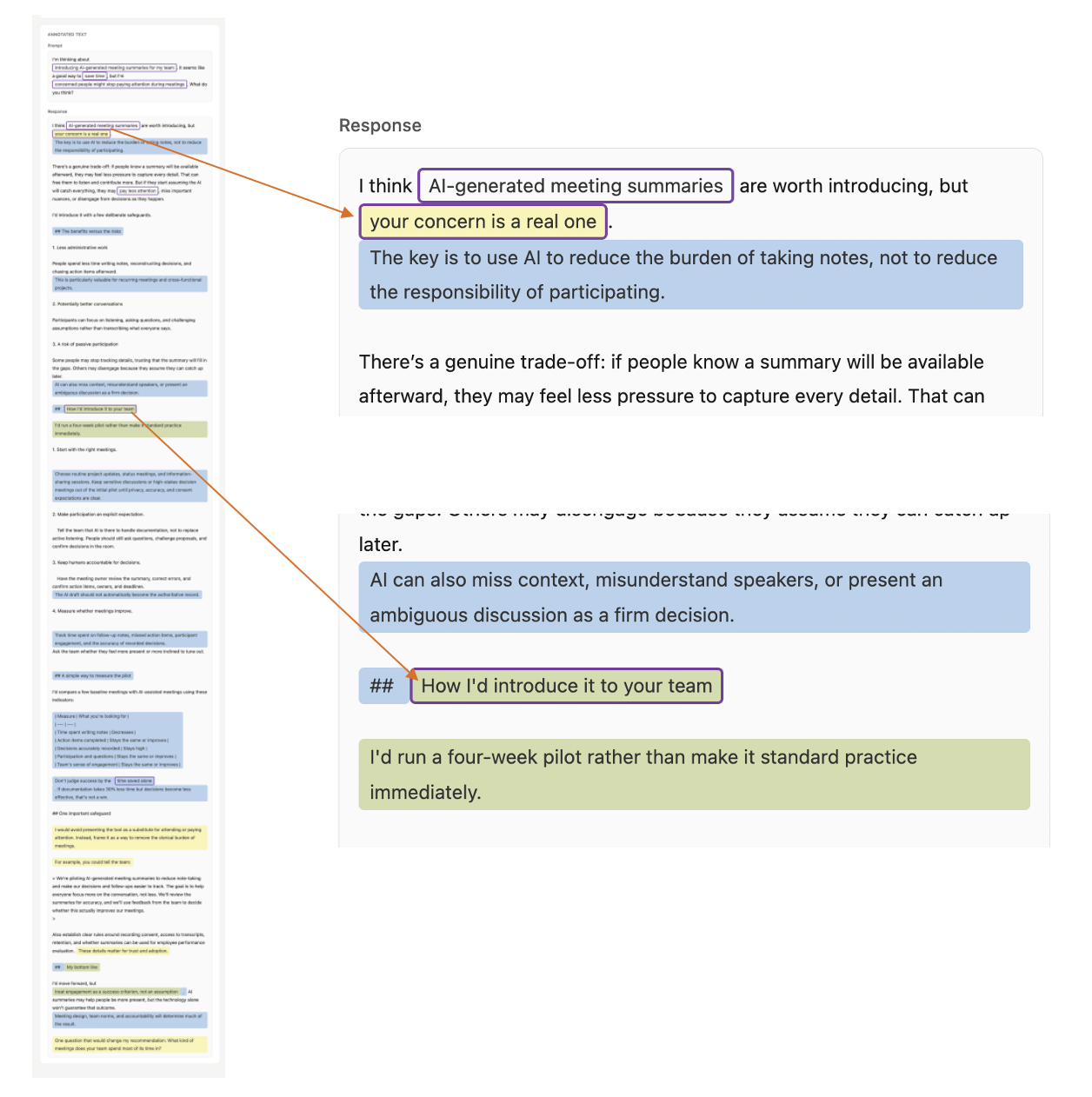
The BE Cue Detector highlights social, expertise and mirroring cues in conversational AI responses.
BE Diagnostic
Examining AI Beyond the Surface.
The BE Diagnostic is an experimental research tool for systematically identifying and examining textual cues that contribute to the believability of conversational AI.
Built to support my exploratory research into the Believability Effect, it uses AI to classify social and expertise cues, provides explanations for its classifications, and allows human reviewers to accept, reject or revise the results.
The tool also produces structured data for further analysis, making it possible to examine patterns across AI-generated responses.
Beyond research, the approach opens up possibilities for independent AI evaluation. Organizations could examine how vendor systems communicate, signal expertise and respond to users, rather than relying exclusively on vendor-provided assessments.
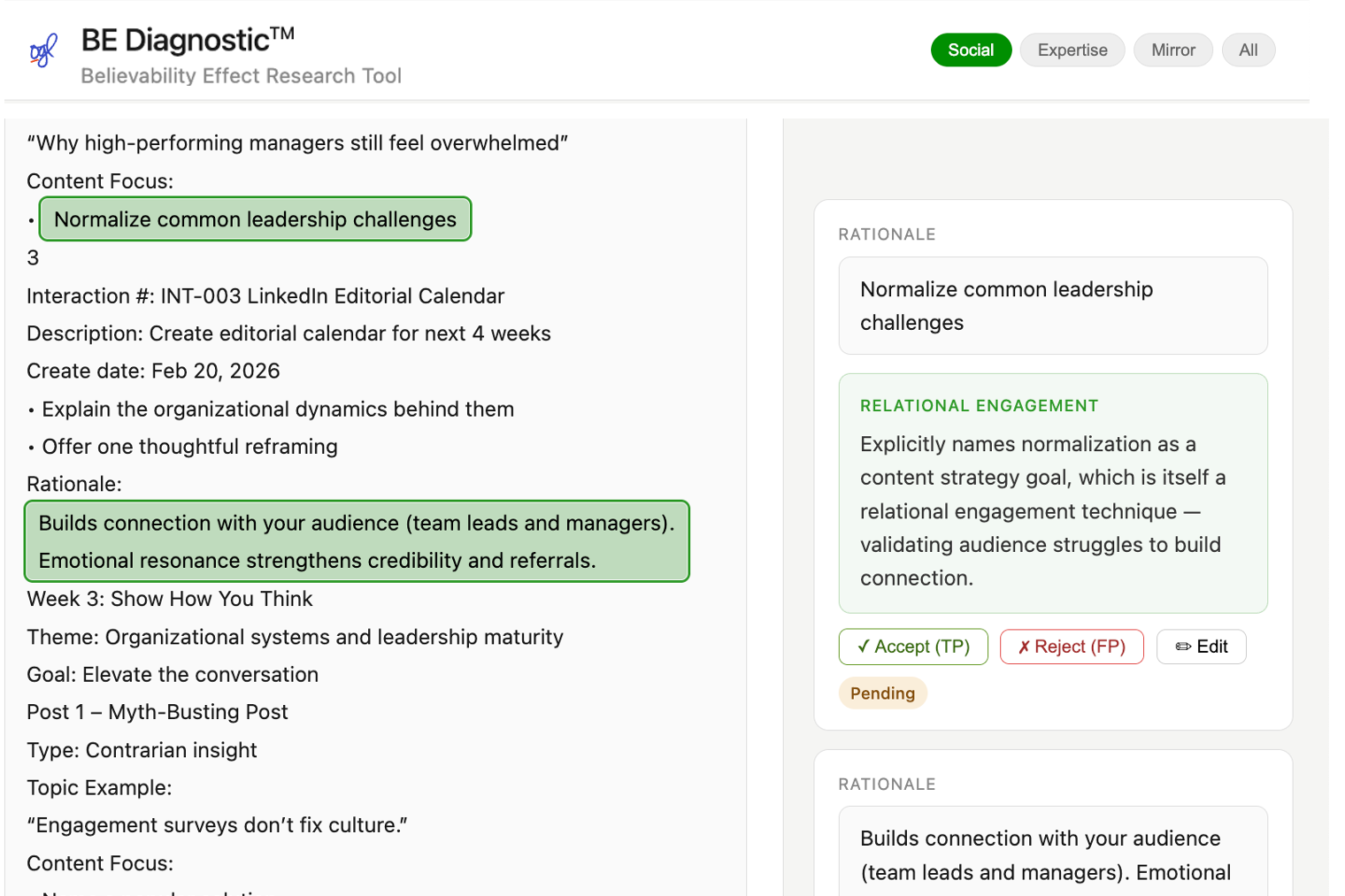
The BE Cue Detector highlights social, expertise and mirroring cues in conversational AI responses.
Experimental Tool
BE Prompt Mirror
AI responses often reflect your own words and ideas back to you. The language you use to describe your situation, your goals, your constraints.
It reappears in the response, dressed up as insight.
This is prompt mirroring.
It’s one of the core mechanisms of the Believability Effect.
The BE Prompt Mirror makes that visible. Enter a prompt and its AI-generated response, and the tool identifies words and phrases from your prompt that reappear in the response.
It highlights specific instances and shows their distribution across the full output.
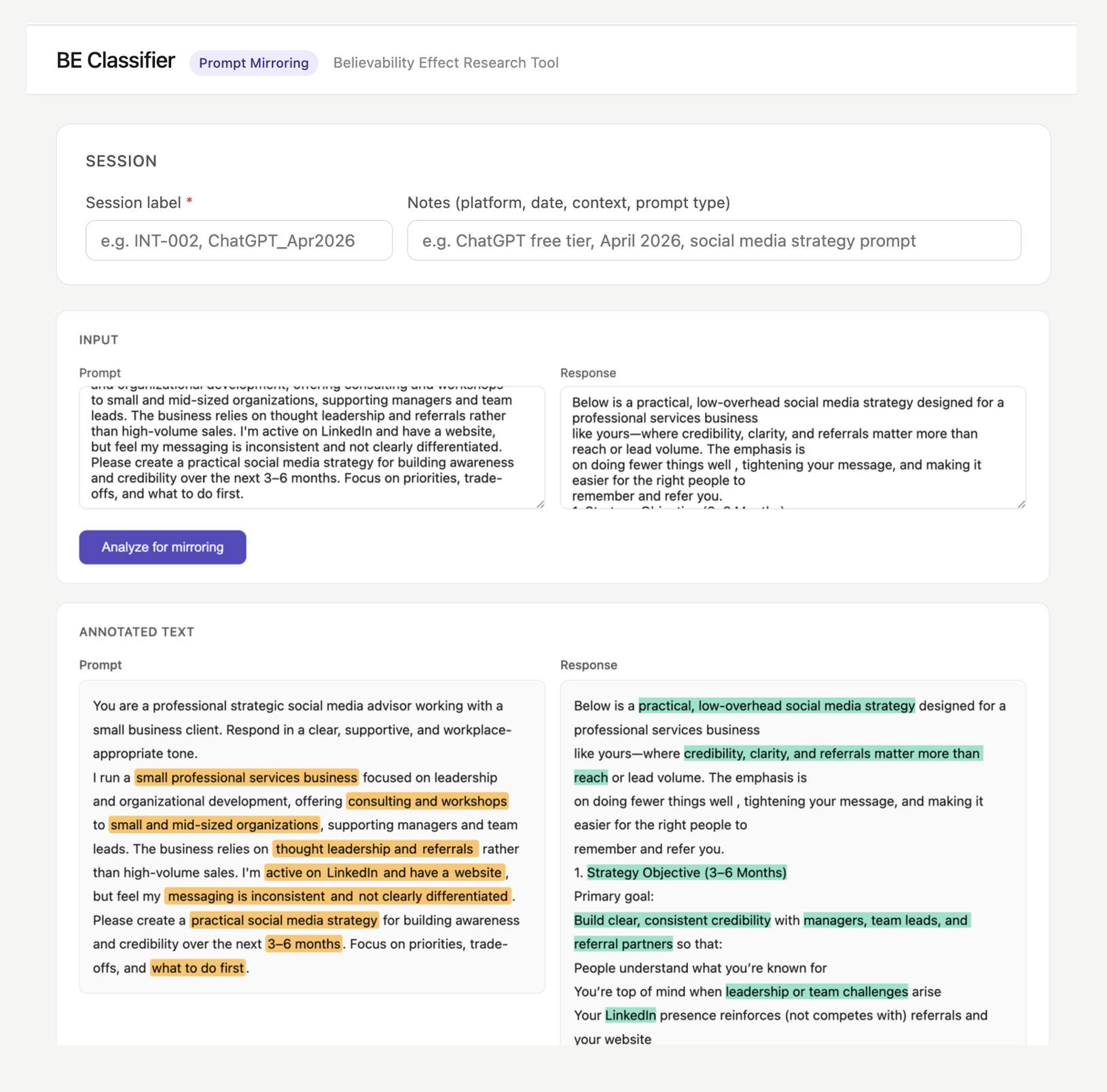
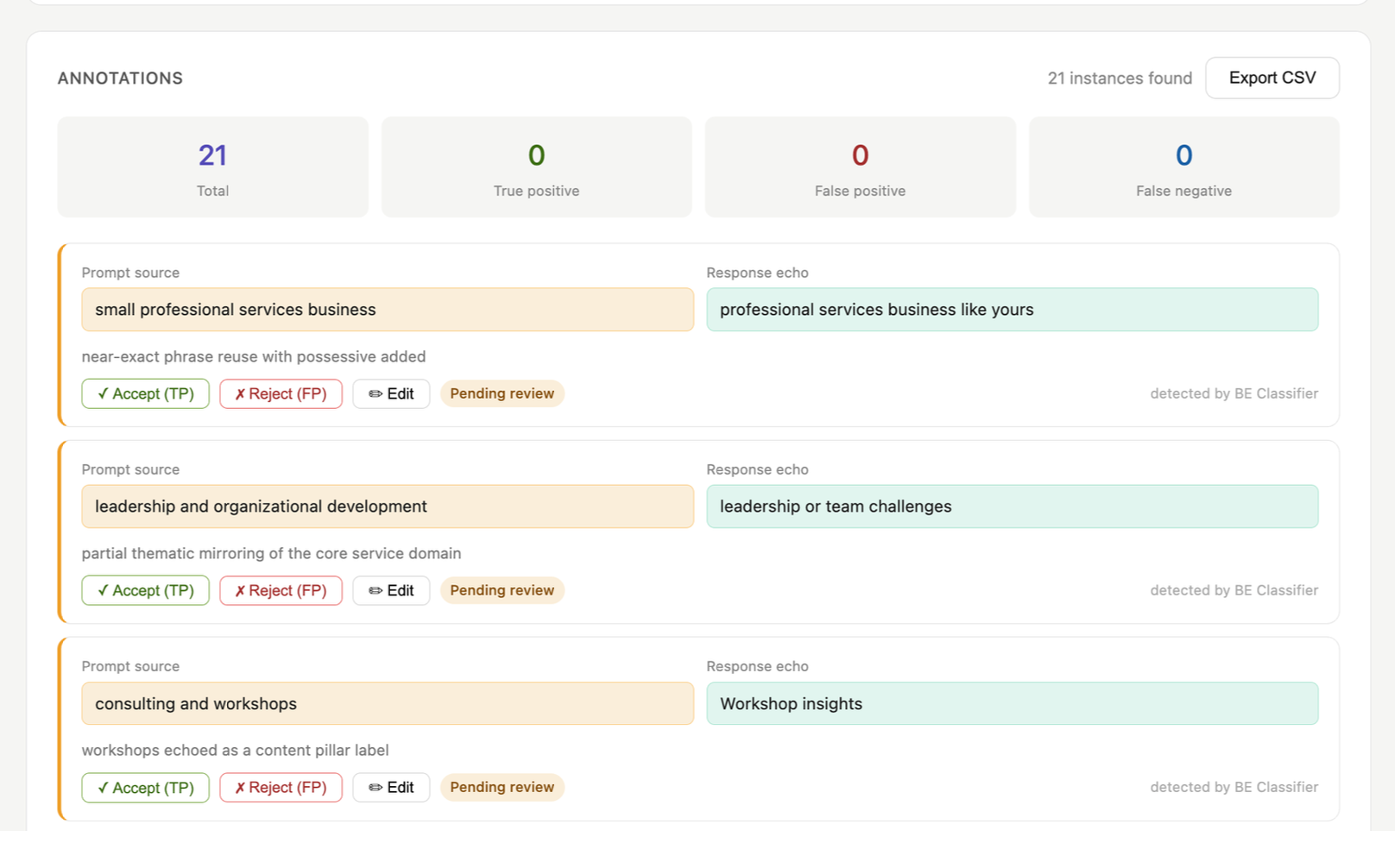
A research validation section lets you review, approve, or reject each label.
Findings export to CSV for further analysis and development of training datasets.
Prompt and response text is not retained. Only the labeled evidence.
Early Prototype
BE Classifier
The BE Prompt Mirror identifies where mirroring occurs. The BE Classifier measures how much believability is present across a full response.
The tool scores an AI response against six dimensions from the Believability Effect framework. Three sociality dimensions (context fit, dialogue, warmth) and three expertise dimensions (structure, reasoning, confidence).
Each dimension receives an AI-generated score with supporting evidence. A researcher override field allows human scoring and interpretive annotation. Score delta between AI and human judgement is calculated and displayed per dimension.
Findings export to CSV. Prompt and response text is not retained. Only the scored evidence.
The schema is designed to support future multi-turn conversation analysis.
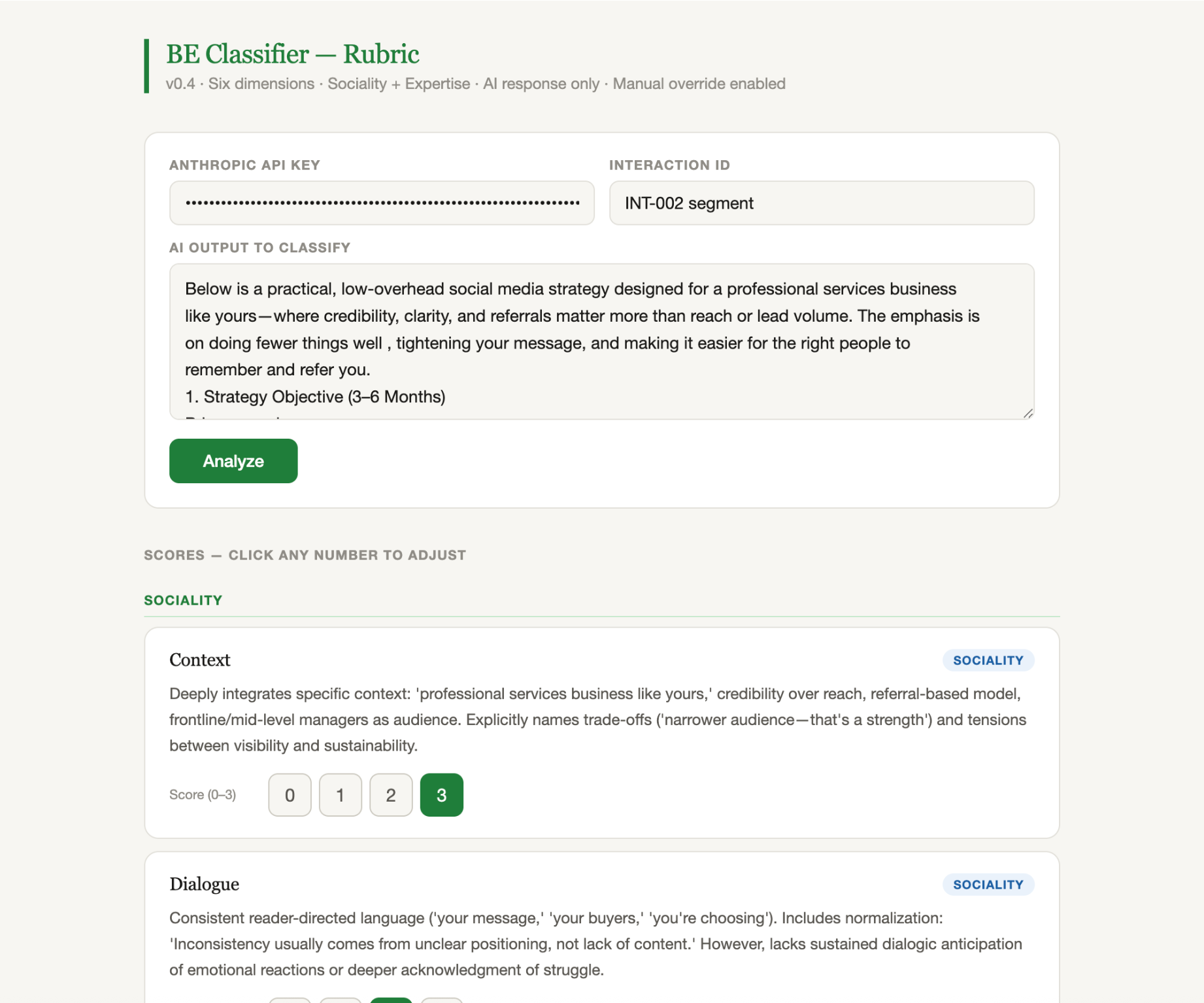
An earlier iteration of the BE Diagnostic.