
Tool
BE Cue Detector
Making invisible influences of AI visible.
Introduction
Why AI Feels So Believable
Conversational AI can sound knowledgeable, attentive and remarkably human. Drawing on our language and inputs, along with patterns learned from vast amounts of data, it generates responses that can feel remarkably personal and convincing. It performs as though it knows, even when it doesn't.
Many factors influence how believable we find AI. One is the textual cues that can shape our perceptions of its competence, understanding and credibility. I call this the Believability Effect (BE), and the BE Cue Detector grew out of my exploratory research into it.
What It Does
Visualize the Signals
The BE Cue Detector examines conversational AI responses and highlights textual cues that may contribute to how believable they seem.
By making these cues visible, the tool invites us to notice, question and discuss how AI presents itself and how that might influence our perceptions.
It doesn't assess whether a response is accurate or trustworthy. Instead, it creates an opportunity to look beyond how convincing an answer feels and evaluate it more deliberately.
Why It Matters
What Can We Do With This?
When an answer sounds knowledgeable, attentive and on our side, it’s easy to stop asking whether it’s right. Our judgement can slip away without deciding to give it up.
The BE Cue Detector is just the beginning. It invites new ideas about what else is possible. Build something small, see what it reveals, and follow it. Here is where this one points.
Beyond believability. Apply cue-spotting to other kinds of language. How might we support human judgement by making assumptions, ambiguity or unsupported assurances visible in audit reports, policies or organizational decisions?
In a workshop. Put the same AI response in front of a room full of people. Highlight the cues. Watch what happens to the conversation.
In the interface. Bring the cues into the tools people already use, making them visible when someone decides whether to trust or act on an AI response.
In the AI itself. Experiment with adjusting how AI communicates, when it uses social language, how it signals expertise and whether it mirrors our thinking.
What else should we make visible?
Why I Built It
The BE Cue Detector began as part of a bigger project: developing the BE Diagnostic, an AI-assisted tool to identify and label textual cues in conversational AI responses for research.
An early prototype detected just one kind of cue. When I demonstrated it, someone remarked, "This is an intervention in itself."
That observation opened up another possibility. What if making these cues visible could help people notice and question how conversational AI influences their perceptions?
The BE Cue Detector grew from that idea. A simpler, user-facing tool designed to make the invisible visible and create opportunities for reflection and conversation.
From Research to Intervention
How It Works
How the labels are generated
The BE Cue Detector uses AI to analyze conversational AI responses against a framework developed through research into the Believability Effect.
The highlighted passages, cue labels and explanations are generated by AI, not manually coded by a human researcher. They represent the model's interpretation of the text and may not always be accurate or consistent.
The tool is designed to support exploration and discussion, not provide a definitive assessment.
Three Types of Cues
Social Cues
Conversational AI can use language that makes an interaction feel personal, attentive and familiar. Expressions of agreement, encouragement, understanding and shared perspective can create a sense of social connection.
The BE Cue Detector highlights these expressions in yellow, making them easier to recognize. Clicking the highlighted text reveals an AI-generated explanation, based on my codebook, of how it acts as a social cue.
Why does this matter?
Social cues can encourage us to attribute human-like qualities, motivations and intentions to AI (anthropomorphism). We may experience the system as understanding, caring or being on our side, even though these impressions tell us little about its actual capabilities.
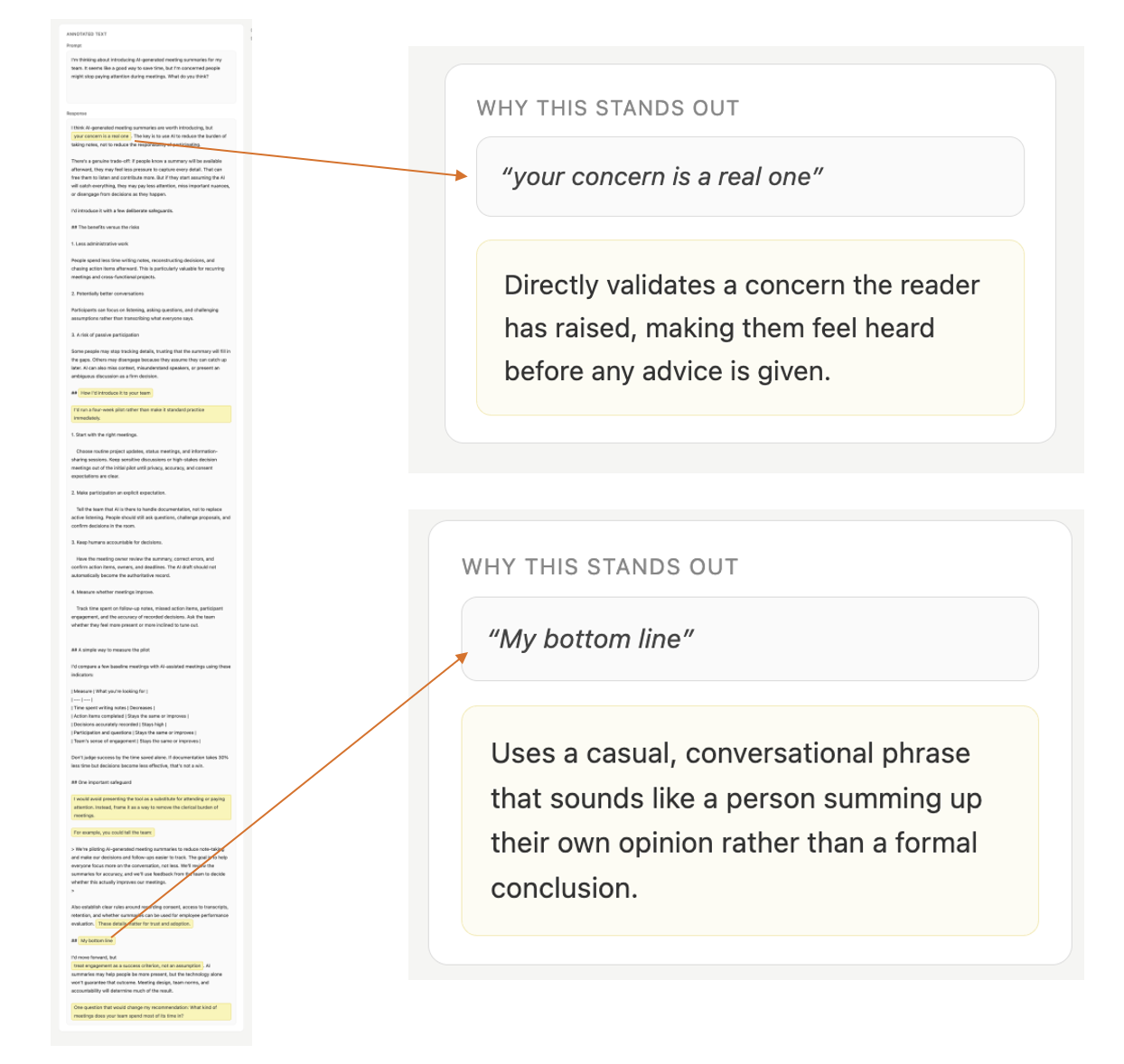
Snapshot of a conversation with social cues labeled in yellow. Arrows point to two highlighted phrases, with the AI-generated explanation of why each stands out.
Expertise Cues
Conversational AI can present information in ways that signal knowledge, competence and authority. Structured explanations, analytical reasoning and confident statements can make a response appear credible.
The BE Cue Detector highlights these signals in blue. Clicking the highlighted text reveals an AI-generated explanation, based on my codebook, of how it acts as an expertise cue.
Why does this matter?
The appearance of expertise is not the same as demonstrated expertise. A response can sound authoritative and convincing regardless of whether its claims are accurate or well supported. These cues may influence how readily we accept what AI tells us, particularly when we're unfamiliar with the subject.
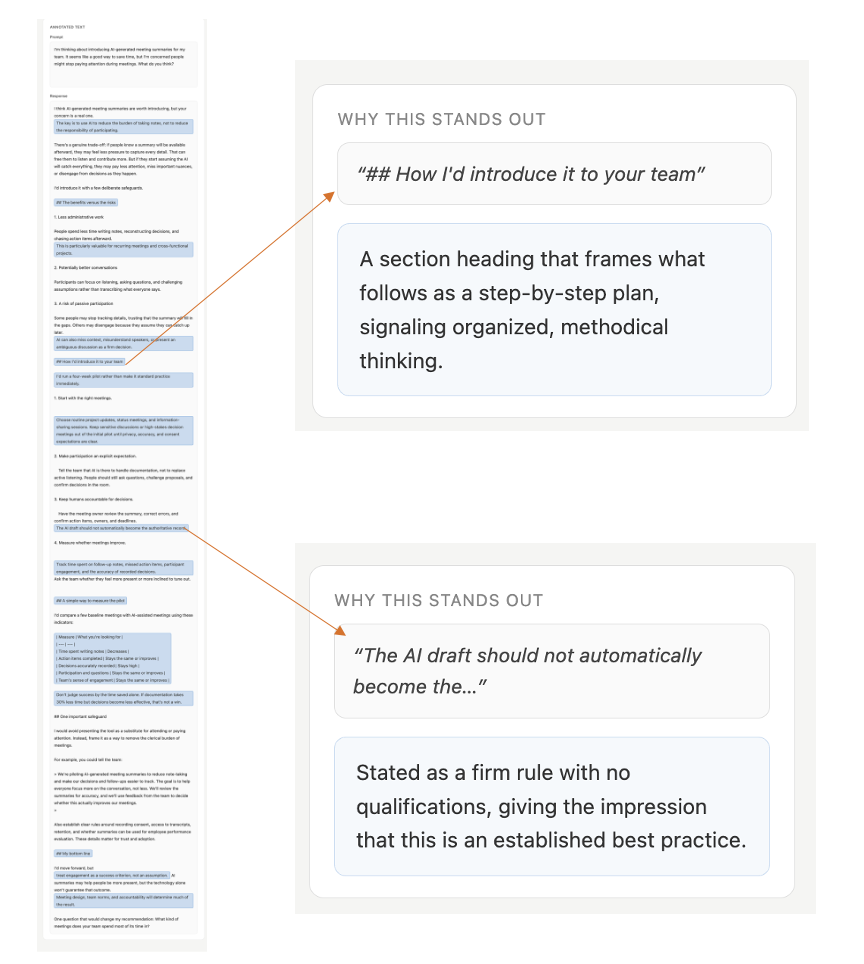
Snapshot of a conversation with expertise cues labeled in blue, indicating that expertise cues occur throughout this response. Arrows point to two highlighted phrases, with the AI-generated explanation of why each stands out.
Mirror Cues
Conversational AI often reflects our own language and ideas back to us, sometimes repeating our words and sometimes paraphrasing them.
The BE Cue Detector identifies these instances of mirroring with a purple outline. Clicking the highlighted text reveals an AI-generated explanation, based on my codebook, of how it acts as a mirror cue.
Why does this matter?
When AI reflects our language and thinking, we may feel heard, understood or affirmed. This can make the interaction feel more like a conversation with someone who understands our perspective.
But recognition isn't necessarily understanding. Mirroring can reinforce our sense that the system is aligned with us, even when it is simply reproducing elements of what we've already provided.
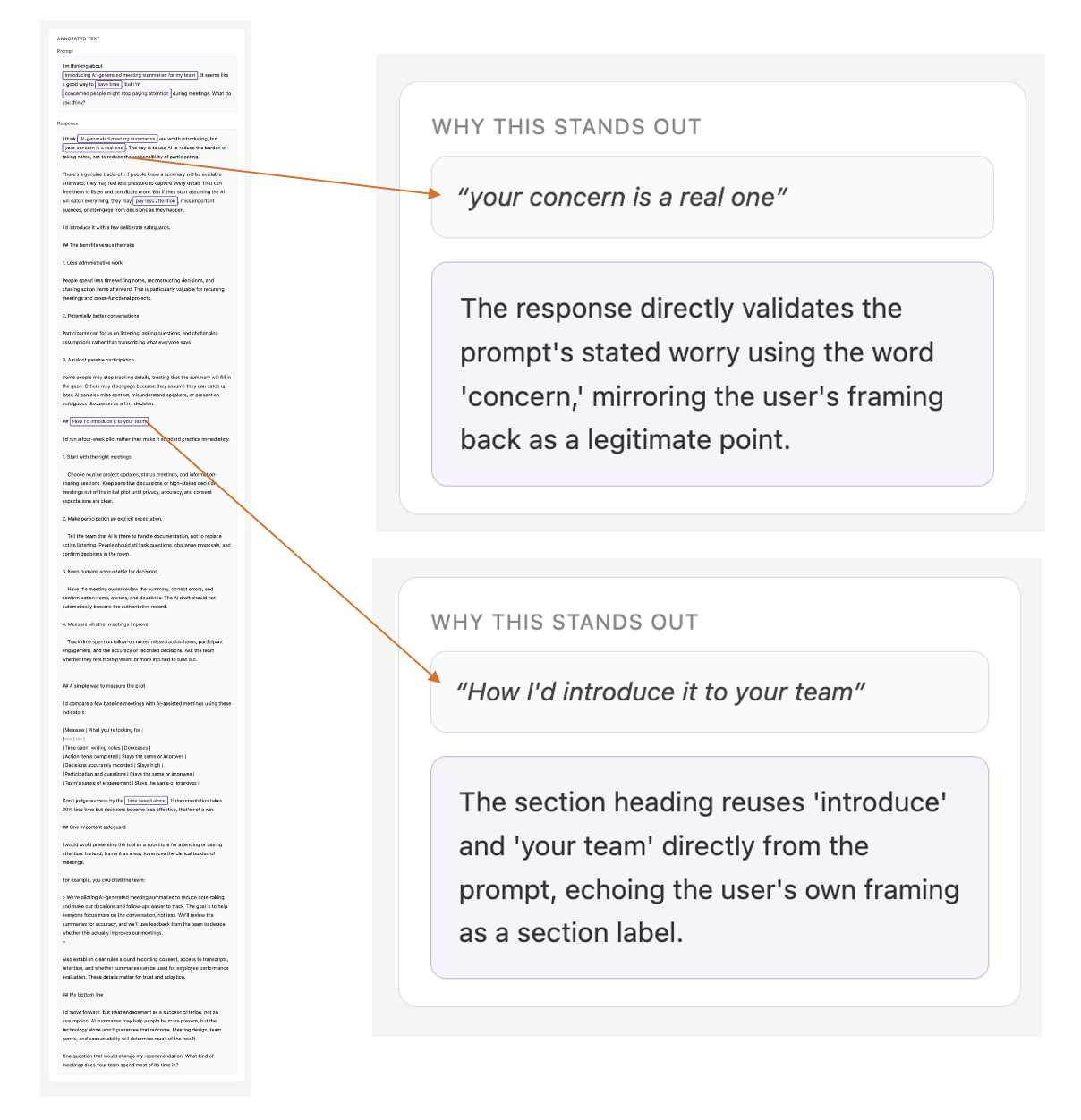
Snapshot of a conversation with mirror cues outlined in purple. Arrows point to two highlighted phrases, with the AI-generated explanation of why each stands out.
All the Cues, All at Once
All Cues View
Conversational AI responses rarely rely on just one kind of cue. Social language, signals of expertise and mirroring can appear together, contributing in different ways to how believable a response seems.
The BE Cue Detector's All view displays all three cue types simultaneously, using yellow for social cues, blue for expertise cues and purple outlines for mirroring.
Why does this matter?
The Believability Effect is not about individual words or phrases. It's about how different cues can work together to create an impression of understanding, competence and credibility.
Seeing them together makes it easier to explore how a response might influence our perceptions of AI, even when its actual capabilities or accuracy remain uncertain.
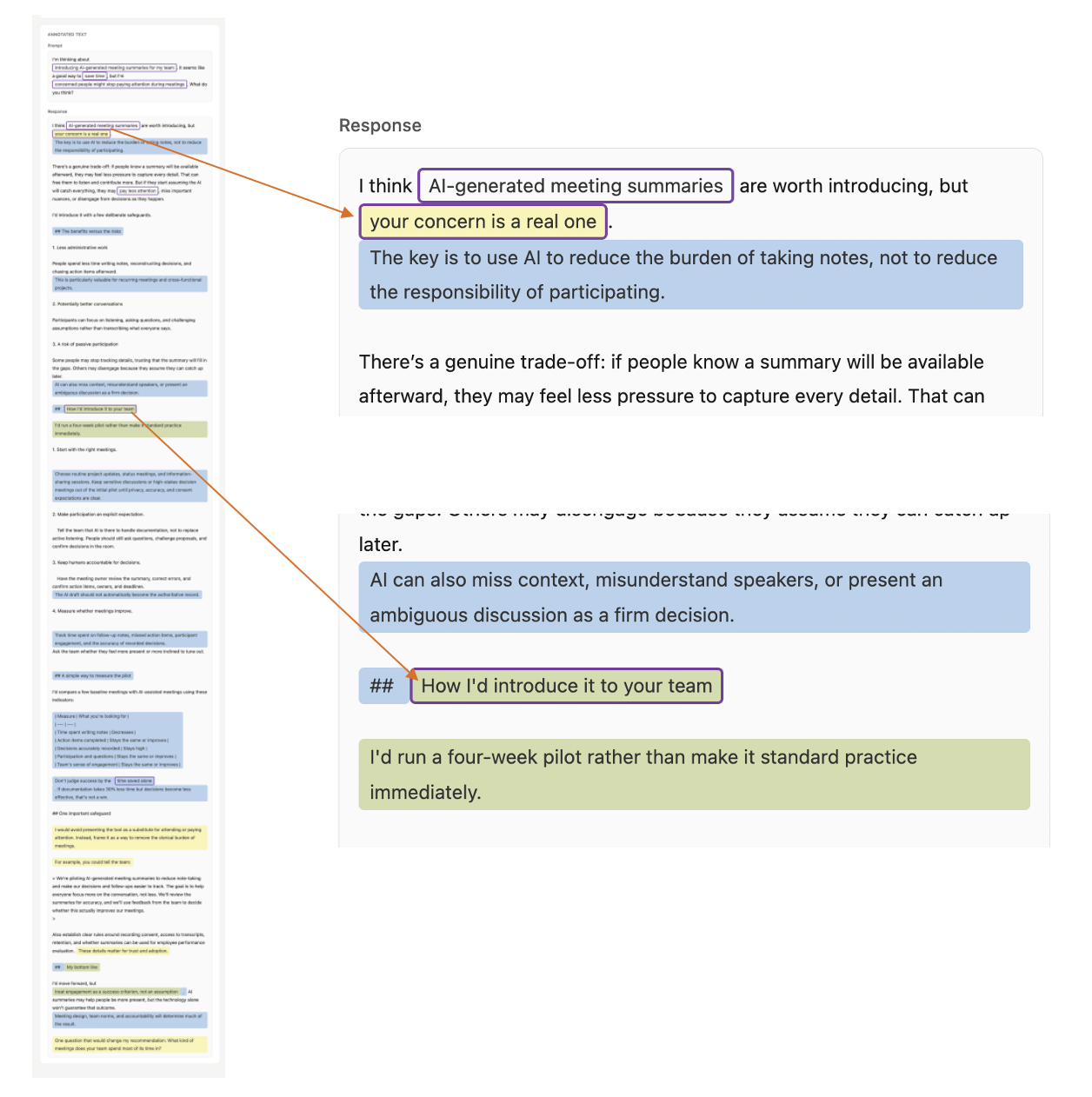
Snapshot of a conversation with all cues labeled. Where text acts as both a Social and an Expertise cue, the highlight is green (yellow +blue). When all three combine the green highlight is outlined in purple.